
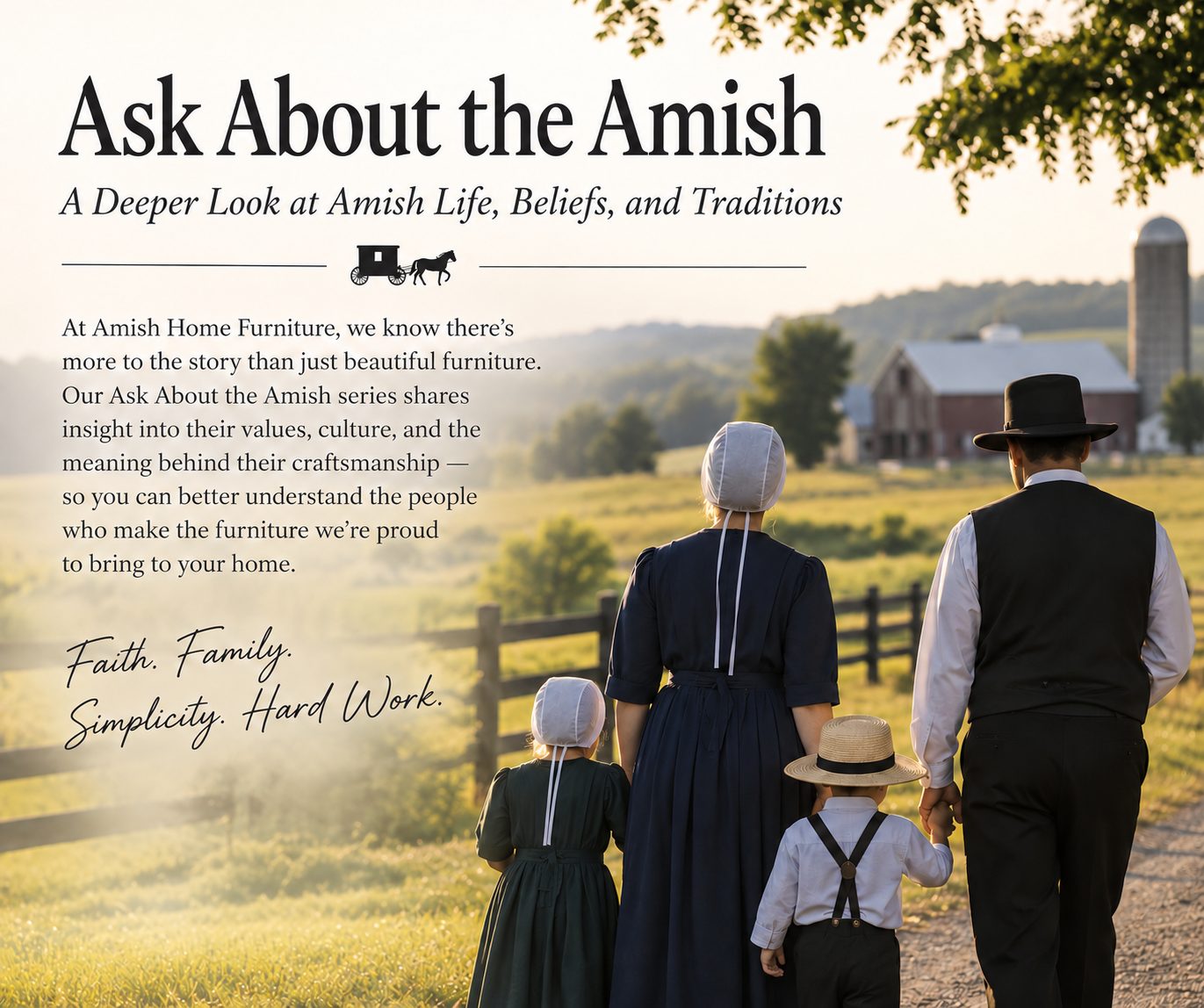
Ask About the Amish: The People, Beliefs, and Traditions Behind the Craftsmanship
Ask About the Amish: The People, Beliefs, and Traditions Behind the Craftsmanship
When people hear the words Amish furniture, they usually think of solid wood, handmade construction, and furniture built to last.
But the story behind that craftsmanship goes much deeper.
At Amish Home Furniture, our relationships with Amish craftsmen are not limited to placing orders from a catalog. Over decades, we have built personal relationships with Amish families and builders across Pennsylvania, Ohio, Indiana, and Virginia. We know many of the craftsmen by name. We have visited their shops, spent time in their communities, and learned firsthand how their beliefs, traditions, and way of life influence the furniture they create.
That is why we created Ask About the Amish.
This ongoing series will explore Amish life, faith, traditions, craftsmanship, family, technology, clothing, community rules, and many of the questions people commonly ask about the Amish.
Not on a rigid weekly schedule.
We will add to the series as we have meaningful stories, experiences, and questions worth sharing.
Our goal is simple: to help people better understand the culture behind the furniture and the craftsmen whose work we are proud to represent.
There Is No Single “Amish Way”
One of the first things to understand is that Amish communities are not all identical.
Different communities and church districts follow their own Ordnung — a set of rules and expectations that guides everyday life. Those rules can influence everything from clothing and transportation to technology, occupations, worship, and family life.
That is why one Amish community may allow certain tools, phones for business, or solar power while another community may follow much stricter practices.
Even communities located relatively close to one another can have meaningful differences.
Understanding that diversity is important, because broad assumptions about “the Amish” often miss how much individual communities can vary.
Faith, Family, Simplicity, and Hard Work
While practices differ, several values are deeply woven into Amish life:
Faith. Family. Simplicity. Community. Humility. Hard work.
The Amish generally place much less emphasis on individual recognition, trends, technology, and convenience than modern American culture does.
Instead, daily life is often centered around family, church, work, responsibility, and community.
That mindset influences everything from how a home is run to how a piece of furniture is built.
There is an emphasis on doing things carefully.
Doing them properly.
And creating something useful rather than disposable.
That is one reason authentic Amish furniture has developed such a strong reputation for craftsmanship.
Why Amish Communities Have Different Rules
A common question is:
Why are some Amish communities much stricter than others?
The answer begins with the Ordnung.
Each local church district has leadership responsible for guiding the community and maintaining its standards. These rules are not necessarily identical from one district to another.
They may address:
Technology Clothing Transportation Farming Business practices Electricity Phones Worship Education
That is why one Amish craftsman may use pneumatic equipment or certain technology for business while another may work under much stricter limitations.
The differences are not necessarily contradictions.
They reflect different communities deciding how best to preserve their religious values and separation from the modern world.
Community Comes First
Amish life is deeply community-oriented.
Families work together, worship together, and depend heavily on one another.
Children learn responsibility early. Skills and trades are often passed from one generation to the next. Worship traditionally takes place in homes rather than elaborate church buildings, with families taking turns hosting services and meals.
That emphasis on family and community also plays a role in craftsmanship.
Woodworking knowledge is often learned through years of hands-on experience.
A young person may grow up around a shop, learning the feel of different woods, construction techniques, finishing methods, and the standards expected by the family or community.
The result is not mass production in the way most people understand it.
It is a craft passed from person to person.
The Amish Communities We Know Personally
Some of our strongest relationships are with Amish builders in Western Pennsylvania, including traditional communities where modern conveniences remain limited.
Those relationships are part of what makes Amish Home Furniture different.
We do not simply know that a piece is “Amish made.”
We often know who made it.
We know the builder's specialty.
We know the quality of the shop.
We know which craftsmen excel with certain woods and designs.
And after decades of working within Amish furniture communities, we have learned that craftsmanship can vary from builder to builder just as it can in any trade.
That experience allows us to be selective about the craftsmen whose furniture we bring into our showrooms.
Why Amish Clothing Looks Different
Clothing is one of the most visible expressions of Amish culture.
Traditional Amish dress is intentionally simple and modest. The purpose is not fashion or individual expression, but humility and conformity within the community.
Specific rules vary by Ordnung, but traditional dress may include:
Men Plain, solid-colored shirts Suspenders rather than belts Simple hairstyles Beards after marriage in many communities Little or no decorative styling Women Long, modest dresses Aprons and cape-style coverings Hair worn up and covered Little or no jewelry or makeup Clothing frequently made within the family or community
The details may seem small to outsiders, but they represent a larger idea:
The individual should not become more important than the community.
What We See When We Visit
Some of the most memorable parts of our relationships with Amish families have nothing to do with furniture.
They are the details of everyday life.
A horse and buggy traveling down a rural road.
Children helping around a family property.
A woodworking shop operating without the technology most modern manufacturers consider essential.
Long clotheslines stretched high between a house and a pole, filled with handmade dresses, shirts, and aprons moving in the breeze.
These are reminders that the furniture we sell comes from a culture very different from the mass-production world.
And while Amish communities are diverse, the craftsmen we work with share a strong pride in creating something useful, substantial, and well made.
The Same Mindset Shows Up in the Furniture
There is a reason authentic Amish furniture feels different.
Real hardwood has weight.
Natural grain varies from board to board.
Joinery, sanding, finishing, and construction require skill.
And when furniture is being built by craftsmen whose reputation travels through their community and through stores like ours, quality matters.
That is why we care so much about knowing the builders.
At Amish Home Furniture, we currently work with 39 exclusive Amish builders, giving us access to craftsmen specializing in everything from rustic hickory and reclaimed oak to black walnut, modern hardwood furniture, custom designs, and Amish-made Poly outdoor furniture.
We know their strengths.
We have seen their work.
And we choose the builders we believe deserve to be represented in our stores.
Why We Created “Ask About the Amish”
Furniture is only part of the story.
The people behind it matter too.
Through Ask About the Amish, we will continue sharing what we have learned through years of firsthand relationships with Amish families and craftsmen.
Future stories may explore questions such as:
Why do some Amish use phones while others do not? Why are Amish communities different from one another? How are Amish children educated? How does an Amish woodworking shop operate? Why do Amish men grow beards? Why do Amish women wear coverings? How are furniture-making skills passed between generations? How do Amish builders work with customers on custom designs? How has Amish furniture evolved into modern styles? What is daily life actually like inside different Amish communities?
We are not trying to speak for every Amish person or every Amish community.
We are sharing what we have learned from the people and communities we know personally.
Authentic Furniture Begins With Authentic Relationships
For us, Amish furniture has never been simply a style.
It begins with real craftsmen.
Real relationships.
Real hardwood.
Generations of knowledge.
And a way of building things that still places enormous value on patience, skill, and doing the job correctly.
That is the story we want customers to understand when they walk through Amish Home Furniture.
Because when you know where the furniture comes from — and who stands behind it — you see it differently.
Authentic Amish craftsmanship. Real relationships. Furniture with a story.
Visit Amish Home Furniture
Ellijay Showroom 10 Northside Square Ellijay, GA 30540
Blairsville Showroom 1839 Blue Ridge Hwy Blairsville, GA 30512
Call or Text: 706-222-7252 Email: Sales@AmishHomeFurniture.com Website: AmishHomeFurniture.com